Have you looked at your electricity bill lately?

(Sept. 8) Residents and businesses are being caught off guard by electricity rate hikes, writes Toby Barrett in The Tillsonburg News. Continue reading

Posted in Power Generation in Ontario | Tagged | 1 Comment

Lawrence Solomon: Another cold Arctic summer

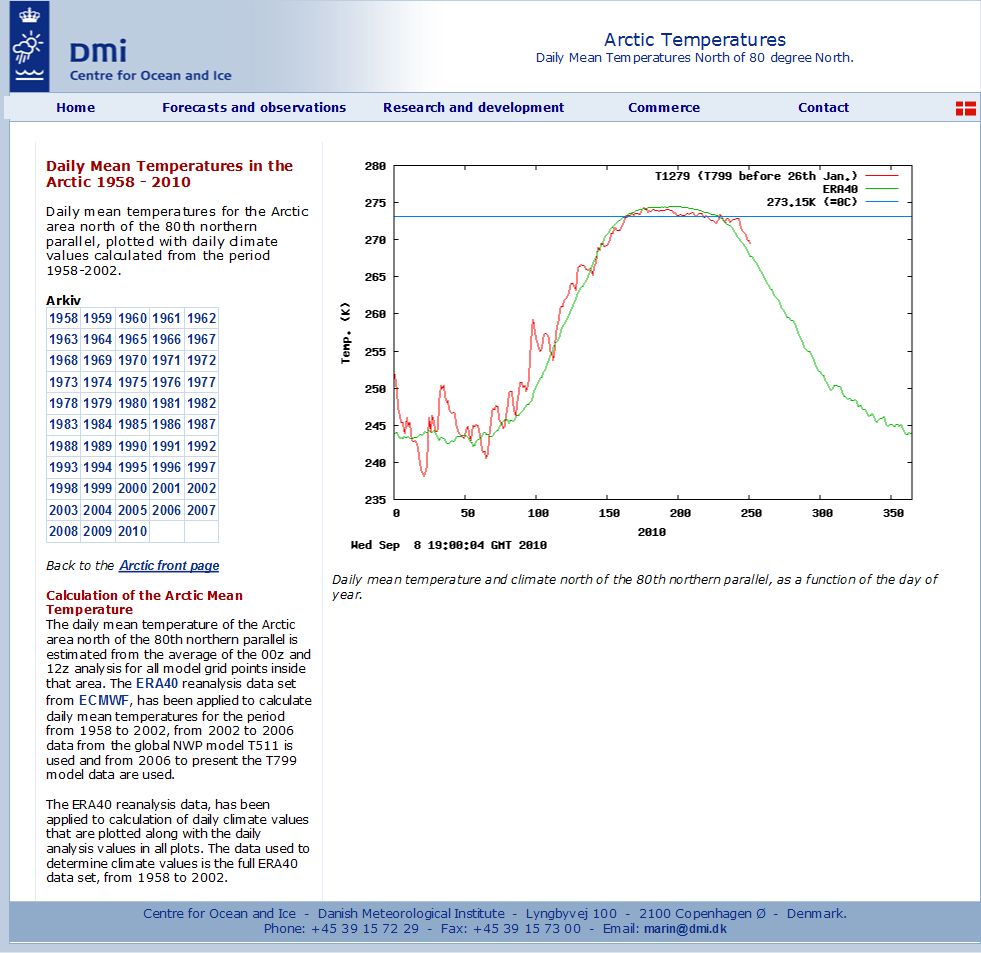
The summer of 2010 was unusually cold, according to the Centre for Ocean and Ice at the Danish Meteorological Institute. For almost the entirety of the June to August period, mean daily temperatures were below the corresponding daily temperatures over the past half century during which the Centre has maintained records.

The cold progress of this past Arctic summer can be seen in the Centre’s graph, seen here. The red line – this year’s temperatures – falls below the green bell curve starting just before Day 150 (late May) of 2010, indicating that just about every day this last summer was colder than normal. The green bell curve represents the historical record — the temperatures that the Arctic has experienced since 1958.

Of even greater significance for those concerned about a melting of the Arctic ice, however, is the graph’s blue line, which indicates the freezing point of water. When the red line appears above the blue line, temperatures are above 0 degrees and ice will melt. As the graph shows, the unseasonably cold summer gave the Arctic a short melt season in 2010. With temperatures in September now plummeting, 2010 is unlikely to log any more melt days, and the Summer of 2010 will go down in the history books as yet another year in which the Arctic did not melt.

Lawrence Solomon is executive director of Energy Probe.

Lawrence Solomon, Financial Post, September 9, 2010


Posted in Climate Change | Leave a comment

Have you looked at your electricity bill lately?

Toby Barrett
The Tillsonburg News
September 8, 2010

Electricity bills are beginning to send shockwaves as ratepayers discuss the latest round of price hikes. Residents and businesses alike are being caught off guard.

Last April, we in Opposition cautioned that an Ontario Energy Board approved rate increase would lead to an annual $350- hike for the average Ontario hydro bill. Causing further concern is the fact that the increase could double once the province’s green energy subsidies are rolled out.

As Energy critic John Yakabuski noted, “It is reaching the point, not all at once but incrementally, just like a leaking faucet, that the sink is going to overflow.” Calls to my office indicate we’re all getting soaked.

What’s more concerning is that people are already seeing increases they can’t afford, and there are still more to come.

Since Spring the McGuinty government’s slate of electricity hikes include:

  • $5 per month on hydro bills by 2012 to pay for the $8 billion renewable energy plan,
  • 8 per cent for the HST
  • 15.7 per cent increase in 2011 and 9.8 per cent increase in 2012 from Hydro One
  • A 6.2 per cent increase from Ontario Power Generation.
  • a charge to help cover $53 million of the government’s conservation and green-energy program.

The Canadian Manufacturers and Exporters Association indicates things will only get worse, reporting power bills will grow by 6.7 to 8 per cent annually for the next five years. That means a household with a monthly bill of $130 today will be paying about $191 by 2015.

As former Executive Director of Energy Probe, Tom Adams put it recently, “You are going to get screwed, and it’s going to be painful.” Adams assigns much of the blame to Ontario’s Green Energy Act, calling government mandated generous payments for large green energy projects, “just outrageous.”

In acknowledging the unaffordable situation electricity rates are causing for residents, Energy Minister Brad Duguid admits government’s coal closure crusade and green energy goldrush shoulder much of the blame: “We know that these central investments in our electricity bills aren’t easy for Ontario families. We’re moving past dirty coal generation to a future of clean renewables….we recognize there is a cost to these measures.”

At payout rates of 80 cents per KWh for solar compared to about 6 cents per KWh for coal, even a first grader could tell that coal closure means rate hikes for the electricity user.

But Minister Duguid has no plan: “We’re in the process now of putting together our long-term energy plan. That will give us a better idea going forward as to what the more accurate cost estimates will be.”

While government crows about its reduction in coal use, the heatwave that has marked the summer of 2010 has seen Nanticoke’s coal burning units running full-tilt. Given that the province is still mired in an industry killing recession one wonders where the extra needed energy will come from if the economy turns around without any coal generators to rely upon.

As we stare down the barrel of McGuinty’s green energy gun, I join those across the province wondering if we can afford to buy government’s high-priced power.

Posted in Energy Probe News, Power Generation in Ontario | Leave a comment

Aldyen Donnelly: The environmental myth of carbon taxes

(Sept. 07, 2010) The myth that carbon/energy taxes translate into green goods-producing job growth is namely that, a myth. In fact, 100% of the incremental job growth in carbon/high energy tax policy-dominated nations has been in the public sector, as goods-producing jobs flee.

For this reason, every nation that introduced carbon taxes/high energy tax policies between 1990 and 1999 has since elected to directly or indirectly reduce their dependence on these highly regressive consumption taxes. The first illustration below shows you changes in goods producing and government jobs, as well as national GHG levels, among key nations.

Note that Canada is the only nation listed that has not realized an absolute reduction in goods-producing employment over the covered period.  While Canada’s government-to-goods-producing jobs ratio (the ratio showing how many government jobs each goods production job is required to support in each economy) has grown, Canada had the lowest rate of erosion in this key ratio among the listed countries. Only Canada and the Netherlands realized total employment increases (including public sector jobs) on track with population growth.

In this table, “goods producing” includes all jobs in forestry, agriculture, fishing, mining, manufacturing, energy production, public utilities and construction. “Public sector” means jobs that are directly, permanently and 100% financed from tax revenues—which is why only a portion of US health sector jobs are included in the “public sector” job count for the US.

A critical error in the economic modelling of GHG mitigation measures that has been completed by and for the NRTEE, Suzuki Foundation and TD Bank is that the models employed value a job in the public sector as equivalent to a job that is privately financed. The models and NRTEE reports forecast that the “put a price on carbon” policies they recommend will result in a shift in total Canadian employment from the private sector to public and rate-regulated industries and that no reduction or constraint in flow of private investment capital into Canada will occur as our shift to a public sector-dominated economy results.

That European tax models have resulted in an unhealthy economic shift should be most apparent to those of you who work in western Canada’s forest sector. Since 1990, much of the EU27’s value-adding forest economy has shut down and EU public rate-guaranteed utilities increasingly depend on wood pellet feedstock imports from Canada—BC, in particular.

Published European economic performance data clearly shows that policies that drive up public sector spending as a % of GDP drive out private capital investment. So the economic models on which these key policy promoters rely are unrealistic in a critical manner.

The second table below gives you a glimpse of Swedish employment trends and how they more-or-less correlate with Sweden’s introduction and then phasing out of its national income to energy tax shift.

Sweden shifted overall governments’ tax burden from income to energy consumption taxes over the period 1990-1992.  Between 1996 and 1998, Swedish officials started to examine the impact of the tax shift on employment trends.

Over that period, Sweden ruled that all energy consumed by power generators, oil refiners and other key value-adding businesses would be 100 exempt from the Swedish CO2, SO2 and NOx taxes. To see all EU nations’ environmental tax exemptions listed go here, the European Enviornmental Agency and OECD Economic instruments Database, scroll to the near-bottom of page and click on “Exemptions in Environmentally Related Taxes.”

The important net results of the introduction of significant industrial exemptions from Swedish environmental taxes include:

  • A significant but unsustainable shift of Sweden’s overall tax burden from the private sector to the public sector.  Private corporations pay income taxes but do not pay environmental, energy or VAT taxes. All public sector agencies, hospitals, universities, schools, etc. do not pay income taxes but pay all energy consumption and VAT taxes. So when the Swedish government financed reductions in income tax rates (and/or cancelled scheduled increases in income tax rates) with revenues from new energy consumption and VAT taxes, that government shifted tax burden from the private to the public sector. In order to absorb the new tax burden, government agencies and publicly-funded institutions had to cut services and increase service fees.  The net result was that mandatory health care and social insurance premiums and payroll taxes increased at more than 5 times the rate of increase in posted (but not always collected) energy tax rates.
  • Over 2000 to 2003, Sweden went further to offer exemptions from all energy taxes (not just environmental taxes, but including excise taxes and all duties) to any “energy intensive business” that could maintain sales while passing tax costs through to customers, where an “energy intensive business” is deemed to be any business for whom the costs of energy (fuel and electricity) combine to account for 3% or more of production costs.
  • After Sweden introduced environmental and energy tax exemptions for key energy-intensive industries were in full effect (by 2002), the goods-producing jobs count in Sweden slowly started to recover.

Note that total employment in Sweden, including all private and public sector jobs, declined absolutely from 1990 through 1999 and did not recover to 1990 levels until 2007.

I am an ardent advocate for GHG regulation in Canada and the incorporation of market measures in that regulation. But consumption and production taxes and quota-based supply management (“cap and trade”) are not among the proved policies I recommend for BC, Alberta or Canada.

Whenever we have been serious about fair and efficient achievement of an environmental, health or safety objective, we have most efficiently achieved that objective with product standards, not consumption taxes or production limitations.

The key to efficient product standards is that government neither: (1) sets price or (2) designs the new products required to comply with our new product standards. Efficient product standards leave it to the market to compete on price and innovation. Consumption taxes and quota-based supply management regimes stifle innovation, limit the return on competition and the latter (the quota-based supply management regime) delivers massive new market power to traditional market incumbents at the expense of innovative new market entrants or incumbents who wish to and are able to innovate.

Unfortunately, all of the economic models that have been employed by the BC government and the NRTEE, to date, to evaluate different GHG management policy options treat production taxes, consumption taxes, quota-based supply management and product standards as identical economic measures.  In this regard, the academic modelers err gravely.

Aldyen Donnelly, September 7, 2010

Posted in Aldyen Donnelly | Leave a comment

A line in the sand: wind power’s ill effects

Two academics from the same university stand on either side of the divide on whether wind farms have negative health effects. According to a recent report, the two professors—Dr. Bob McMurtry, dean of the medical school at the University of Western Ontario from 1992 to 1999 and Dr. David Colby, an associate professor and medical officer of health in Chatham-Kent—are likely to be witnesses on opposing sides in a potential landmark case in Ontario’s Edward County challenging the province’s ambitious and controversial Green Energy Act.

Dr. McMurtry, who believes wind farms may bring with them health drawbacks for those living in their vicinity, says both pollution and climate-change could be easily addressed without building wind farms. He’s calling on the province—if it does move ahead with its wind energy plans—to spend $1 million on research to determine how far back turbines need to be to safeguard health.

Current regulations call for a 550-metre setback, but he believes a two-kilometre buffer is needed.

Dr. Colby, on the other hand, reviewed numerous studies on wind turbines, both for the Chatham-Kent council, and later for the wind power associations, and said peer-reviewed studies show no link between ailments and turbines—except for a small number of people upset by the turbines that then created stress, which could be the cause for some of the symptoms.

And though it may appear that the debate on wind turbines is academic, that’s certainly not the case. Opposition to wind turbines has been fierce across the province in proposed sites.

That opposition may become even fiercer as the Ontario government continues to offer handsome subsidies to wind energy developers in the effort to shut down the province’s coal plants and “green” its image. One report says the Ontario government has, “given its blessing to a wind industry that may build $20 billion worth of turbines across the province and in its lakes.”

Energy Probe is a keen supporter of renewable energy. We believe renewable energy has the ability to diversify our electricity supply, while allowing for more decentralized sources of power for consumers. But we’re not in favour of throwing massive subsides at forms of energy that are not technically or economically feasible.

Read the previous gangrene economy report, "Organized Crime Greasing The Wheels Of Europe’s Wind Industry" here.

Posted in Uncategorized | Leave a comment

Aldyen Donnelly: The expensive (Ontario) way to reduce emissions

(Sept. 1, 2010) The Ontario government’s plan to turn off coal and switch to biomass at the Atikokan Generation Station is a VERY expensive way to reduce Greenhouse Gas (GHG) emissions.

I am all for the generation of electricity from biomass/pellets. But EVERY European biomass-fired and co-fired electricity generation unit also produces a significant amount of heat (steam and/or hot water) that is supplied into a district heating system.

It is the co-generation of heat that makes the numbers work.

60% of Danish residential and commercial space and water heating is supplied through a hot water distribution system. 80% of the hot water in Denmark’s district heating system originates at old power plants that are co-fired with coal and wood pellets.

Atikokan is too far away from any sizable community to be a cost-effective district heat supplier. This is the wrong plant to convert to biomass. A major modification to accommodate biomass feedstocks at the Thunder Bay power station potentially makes MUCH more sense.

When you operate those boilers to generate electricity, they are working at a 30% to 40% (max) efficiency rate—lower if you’re burning biomass, nearer the high end if you are burning coal. When you co-generate useful heat at the same boilers, you are cranking up the efficiency rate (BTUs of energy in for BTUs of useful energy out) to 75% to 90% (depending on technology and fuel), even if the boilers are quite old.

It is only when you are switching to biomass AND cogenerating marketable heat—best bet in Ontario is hot water for district heat, as opposed to steam, which can be cost-effectively moved over distances up to 55 km. Building hot water transmission capacity is typically significantly less expensive than building incremental capacity to transmit electricity.

The role of district heat—and the role of old coal-fired power plants in the supply of hot water for district heating networks—in a national energy efficiency and GHG reduction strategy is well understood in both Europe and the US. In fact, every US climate change bill that has passed 2nd reading or better since 2006 (including the Waxman-Markey bill which passed 3rd reading in the House) includes the following provisions, which are expressly intended to dissuade utilities from de-commissioning old coal-fired boilers if/when they are positioned to supply district heat.

From the Waxman-Markey climate change bill, passed by the House in 2009 (identical language appears in two subsequent Senate draft bills):

In Section 102, “Definitions”, the bill defines “utility units” (page 282) as follows:

`(54) UTILITY UNIT- The term `utility unit’ means a combustion device that, on January 1, 2009, or any date thereafter, is fossil fuel-fired and serves a generator that produces electricity for sale, unless such combustion device, during the 12-month period starting the later of January 1, 2009, or the commencement of commercial operation and each calendar year starting after such later date—

`(A) is part of an integrated cycle system that cogenerates steam and electricity during normal operation and that supplies one-third or less of its potential electric output capacity and 25 MW or less of electrical output for sale; or

`(B) combusts materials of which more than 95 percent is municipal solid waste on a heat input basis.

This definition is repeated in the definitions for Section 111 (starting page 283), which definitions apply to the allocation of GHG allowances as well as the emission caps and obligations to surrender allowances that apply under the law.  The wording in these sections explicitly states that the new obligations to cap emissions and surrender allowances applies ONLY to “utility units” and not to electricity generating units that are deemed not to be utility units.

In other words, the above definition of “utility unit” affects an exemption from the new cap and trade obligations for combustion devices that meet the criteria outlined in (A) or (B) above. By definition, this is a very significant incentive for US owners of existing coal-fired power generation units to cogenerate steam (which they may or may not condense into hot water) and use the combustion units to supply heat into a District Heating system in lieu of using those units primarily to make electricity.

I am worried that Ontario’s early GHG reduction projects will be so expensive the net result will be a loss of public support for further measures to reduce GHGs in the province. Instead of the FIT—where government both sets prices and picks technologies, with all of the related complications and inefficiencies—Ontario should put a legally binding Renewable Energy Standard (“RPS” or “RES”) in place (with the broadest possible definition of “renewable” and including building efficiency upgrade projects as renewable energy credit-earning and where 277.778 Pjs of biofuel sales equates to 1 MWh of renewable power sales).

Instead of picking specific power generation units to fire or co-fire biomass, the Province should incorporate an exemption from the RES for existing coal-fired generation units that are converted to co-generate district heat, and issue RECs to those units, where 10,000 lbs of steam-equivalent hot water equates to 1 MWh of renewable power and earns a REC—whether that steam is 100% generated from biomass or 30% biomass/70% steam.

Aldyen Donnelly, September 1, 2010

Posted in Aldyen Donnelly | Leave a comment

Aldyen Donnelly: Use product standards, not tariffs

(Aug. 31, 2010) Implementing tariffs to discriminate against environmentally subsidized imports is a horrible—and very 1950s—idea.

When we decided that it was unhealthy to sell toys in Canada that were covered with leaded paint, did we: (1) prohibit the manufacture of leaded paint in Canada and (2) put a tariff on leaded paint and leaded painted toy imports? Certainly not. Everyone involved agreed that would have been a stupid idea. So why are we seriously contemplating such a stupid idea to address the damage of GHGs and other pollutants?

When we wanted to get the lead out of gasoline and paint, PCBs out of electricity components, DDT out of pesticides, sulphur levels down in diesel, or CFCs out of refrigerants, we did not regulate domestic manufacturers and put tariffs on imports, as proposed in Jeff Rubin’s article.

In EVERY case of successful environmental management outcomes we did the same thing.

We first regulated the pollution factor and/or content for pollution precursor products, at the point of sale—not the point of manufacture or import. To the extent that we prohibited the manufacture of polluting products or pollution precursors in Canada, we only did so after North American product standards created significant demand for more environmentally benign versions of those products.

Efficient and effective regulation will not involve any tariffs. Effective regulations will say that every distributor of petroleum products in Canada has to report global supply chain fossil carbon consumption and comply with fossil carbon content limits (on a Canadian sales portfolio basis) that decline over time.

We only have to put supply chain carbon/GHG reporting and content limits in place for nine basic commodities to cover 85% of North America’s global supply chain emissions. 80% of the least cost measures industry will apply to comply with the reduction obligation will also result in local air pollution reductions.

Why are we talking tariffs—which will be the start of trade wars—when we clearly know how to get this right and also know that tariffs are inefficient? Regulate products sold, and not manufacturing techniques. Leave it to the market to come up with the manufacturing techniques required to comply with the product standards.

Product standards treat all products sold equally, regardless where the products are manufactured.

Learning from past experience

I should note that every time we have regulated products to achieve environmental protection goals, (1) Canada has regulated domestic production as well, but (2) the US has exempted exports. Consistent with this history, the US Congress has even included an exemption from proposed US GHG caps for all GHG sources that are producing exported products in every climate change bill that has passed 2nd reading on the House or Senate since January 2006.

We can afford to regulate what is manufactured here only if/after our product standard regulations have created a large enough demand for environmentally superior products, and only if the US removes the export exemption from its existing and proposed regulations.

Every time Canada has regulated both sales and production, the US has subsidized US producers of the regulated products by allowing them to continue to produce and dump polluted/polluting products on developing world markets. A system of tariffs just makes the return on dumping worse.

The ultra low sulphur diesel case

For example, in 2006 it became illegal to sell diesel fuel that was greater than 15 parts per million (ppm) sulphur through the retail distribution networks in both Canada and the US. In Canada, it became illegal to manufacture high sulphur diesel in the same year. But the US did not completely prohibit the production of high sulphur diesel.

Up until 2006, the US was a net importer of diesel fuel. After 2006 the US became a net exporter of diesel fuel. 100% of the US’s incremental diesel exports are high sulphur diesel, and most of these exports are going to developing nations in South America or to developed nation refineries where the high sulphur diesel is blended with their low sulphur production before the finished blend is exported to developing nations.

The US refinery dumping of high sulphur diesel on the developing world market mirrors the US dumping of leaded gasoline starting in 1990, after the completion of the US domestic leaded gasoline phase out.

Most of the gasoline export increase you see pictured below was in the form of leaded fuel from 1980 through roughly 1995. Congress eventually approved regulations prohibiting the manufacture of leaded gasoline in the US in 1996. Having established new export market share with leaded fuel exports, the US refineries maintained and continued to grow those export market shares by substituting unleaded for leaded fuel.

Western Climate Initiative

Note, as well, that the California GHG standard for electricity and Low Carbon Fuel Standard—the critical measures the states/provinces participating in the Western Climate Initiative have agreed to—effectively exempt product that is manufactured in California/the WCI states/provinces, but is exported, from the GHG limits.

Canada unity at risk

Please also note that if/when Canada/the provinces agree to a domestic “cap and trade” set of rules (where “cap and trade” regulates GHGs at the point of production, not the point of sale) and levels the playing field with tariffs on imports, if Canada replicates the US historical and proposed GHG bill models, all Canadian production destined for export markets will be exempt from Canada’s GHG caps.

This has major implications, including but not restricted to:

  • many of the larger GHG sources in western Canada will be exempt from the national GHG cap and trade regulations, but
  • most of the cost of import tariffs will be paid by consumers living in Ontario and Quebec.

I do not believe that any such outcome will prove acceptable to the residents of Ontario and Quebec.


Aldyen Donnelly, August 31 2010

Posted in Aldyen Donnelly | Leave a comment

Looking at NB Power numbers

(Aug. 28) Norm Rubin with the Toronto-based energy watchdog group Energy Probe  says he is concerned that NB Power might be forced to go too far in cost-cutting efforts in order to freeze the power rate, postponing such things as required maintenance, writes W.E. (Bill) Belliveau in the Times and Transcript. Continue reading

Posted in New Brunswick Power, Nuclear Waste | Leave a comment

Looking at NB Power numbers

(Aug. 28, 2010) As Prime Minister Harper rattles around the Arctic pumping the need for fighter planes and Arctic sovereignty and warning of Russian bomber threats that justify the recently announced $9 billion dollar purchase of U.S. manufactured fighter planes, NORAD, the North American Aerospace Defense Command says that at no time did Russian bombers enter Canadian airspace this week. Continue reading

Posted in Nuclear Safety | Leave a comment

Looking at NB Power numbers

W.E. (Bill) Belliveau
Times and Transcript
August 28, 2010

As Prime Minister Harper rattles around the Arctic pumping the need for fighter planes and Arctic sovereignty and warning of Russian bomber threats that justify the recently announced $9 billion dollar purchase of U.S. manufactured fighter planes, NORAD, the North American Aerospace Defense Command says that at no time did Russian bombers enter Canadian airspace this week.

Coincidently, a few miles away in Nunavut a huge chunk of ice broke off Ellesmere Island. Scientists estimate the size of the ice chunk at roughly the size of Bermuda. Could this be another piece of the global warming threat and is anybody paying attention?

On another matter, notes to the 2009 (year ending March 31, 2009) Financial Statements of NB Power relating to refurbishment of the Point Lepreau Generating Station say that “costs of replacement power will be recovered from customers over the station’s operating life and reflected in . . . charges, rates and tolls to customers.” Meanwhile, it will defer costs and capitalize interest payments – a method of creating paper profits. It does not reduce the need for cash. In an early 2010 election undertaking, Progressive Conservative Leader David Alward has promised voters a three-year freeze on power rates if his party wins the Sept. 27 election.

With the greatest respect for Mr. Alward, one has to wonder about the feasibility of his promise. Cost over-runs and power replacement costs for the Lepreau refurbishment could be $2- to $3-billion before it’s finished, if it is ever finished.

Let’s be optimistic and assume the nuclear generator will be up and running by January 2012 and total costs of over-runs and power replacement costs prove to be as little as $3 billion. Based on notes to the financial statements referred to above and assuming a plant life of 25 years, the charge to ratepayers for capital recovery would be $120 million a year (not including interest costs). With five per cent interest rates the annual cost of interest would be another $150 million, more than double the reported profit of NB Power in 2009 ($70 million). How does a rate freeze fit into that scenario?

NB Power has already warned that it needs future rate increases to pay for the financial setbacks of the $1.4-billion refurbishment at Point Lepreau. Interest and capital recovery alone would require a rate increase of at least seven per cent ($40 million per point) and that could be on top of revenue-losses over three years – the result of a rate freeze – short-term gain for long-term pain.

Norm Rubin with the Toronto-based energy watchdog group Energy Probe
says he is concerned that NB Power might be forced to go too far in cost-cutting efforts in order to freeze the power rate, postponing such things as required maintenance. “You have to be careful that you don’t put too much financial pressure on a utility, especially one that’s always been Crown-owned and hasn’t been pressed before,” he said.

Rubin says freezing rates without knowing when Atomic Energy of Canada Ltd. will complete the refurbishment of the Point Lepreau nuclear power plant (2.5 years behind schedule) is “a recipe for disaster.”

To be clear, Energy Probe has an agenda. Founded in 1969, the organization believes that nuclear power is uneconomic. It claims to have been successful in stopping the construction of all nuclear plants in Canada proposed since that date.

Even though the province’s 90-year-old power utility is saddled with a debt of $4.75 billion, Alward says his idea is feasible based on an analysis done by a former NB Power vice-president and two consultants.

Mr. Alward is also promising to appoint an energy commission to map the province’s energy strategy for the next decade if he wins the Sept. 27 election. His party’s “discussion paper”, including the recommended three-year rate freeze, relies on analysis by Darrell Bishop, a former vice-president at NB Power. Bishop told a news conference that “lower fuel prices, combined with a recent three per cent rate increase” has put NB Power in a position where it can operate profitably despite the rate freeze.

Nobody in the world can guarantee future energy prices. Any cost assumptions based on future energy prices are guesstimates at best and wishful thinking at worst. David Alward’s counterpoint: “NB Power is in good shape and is able to allow rate freezes going forward over the next three years and still pay down the debt (because) it is still a profitable company.”

Energy Minister Jack Keir says he is astonished at Bishop’s participation on the Tory panel considering that just a year ago, when he was NB Power’s vice-president of generation, he was requesting rate increases for the utility. Bishop is not a financial analyst or a cost accountant; he is an engineer with some high-level experience in customer service and marketing.

Posted in Energy Probe News, New Brunswick Power | Leave a comment