Chilling evidence

Financial Post
Two years ago, William Livingston and Matthew Penn of the National Solar Observatory in Tucson, in a controversial paper that contradicted conventional wisdom and upset global warming theorists, predicted that sunspots could more or less disappear after 2015, possibly indicating the onset of another Little Ice Age.

As they stated then, “the occurrence of prolonged periods with no sunspots is important to climate studies, since the Maunder Minimum was shown to correspond with the reduced average global temperatures on the Earth.” The Maunder Minimum lasted for approximately 70 years, from about 1645 to 1715, and was marked by bitter cold, widespread crop failures, and severe human privation. They concluded their 2008 paper by noting, “Finally, observations of this type during the onset of the next sunspot cycle will be critical in determining if the observed trends continue.”

We are now in the onset of that next sunspot cycle, called Cycle 24 – these cycles typically last 11 years — and Livingston and Penn have this month published new, potentially ominous findings in a paper entitled Long-term Evolution of Sunspot Magnetic Fields: “we are now seeing far fewer sunspots than we saw in the preceding cycle; solar Cycle 24 is producing an anomalously low number of dark spots and pores,” they report.

Their conclusions have potential “dramatic implications.” Cycle 24 could have just half the number of sunspots as the recently completed Cycle 23, and there could be “virtually no sunspots in Cycle 25.” The implications of their research points to decades of spotlessness.

The authors base their conclusions on the assumption that recent trends will continue, an assumption that, they note, may well be proven in time to be false. At the same time, given that their findings are consistent with those of other solar scientists, and given the stark implications of another little ice age for society at large, they felt compelled to publish a warning.

“It is important to note that it is always risky to extrapolate linear trends; but the importance of the implications from making such an assumption justify its mention,” they state.

The upshot for scientists and world leaders should be clear, particularly since other scientists in recent years have published analyses that also indicate that global cooling could be on its way. Climate can and does change toward colder periods as well as warmer ones. Over the last 20 years, some $80-billion has been spent on research dominated by the assumption that global temperatures will rise. Virtually no research has investigated the consequences of the very live possibility that temperatures will plummet.  Research into global cooling and its implications for the globe is long overdue.

Lawrence Solomon is executive director of Energy Probe and the author of The Deniers. LawrenceSolomon@nextcity.com. Click here for the authors’ 2008 and 2010 studies.

Posted in Uncategorized | Leave a comment

Aldyen Donnelly: Denmark’s wind problem

(sept. 14, 2010) Unfortunately, the Danish wind industry is living up to my prior forecasts—evidence can be found most easily in the fact that here were no new turbines built in Denmark between 2006 and 2009.

In 2009 the Danish government approved applications for developers to site 1,300 MWs of capacity onshore—1/3 of which were replacement turbines, not incremental capacity.  But the condition of approval was that from then on all new wind power project developers would be required to compensate affected Danish landowners for declines in their property values.

Most of the incremental capacity that was approved under that condition has not been developed.

More importantly, the last 12 wind turbine manufacturing and/or assembly plants that have been constructed by “Danish” companies have been built outside Denmark—including five in North America. Denmark has been a net importer of wind power technology for at least 3 years.

In other words, Danish household rate-payers pay over CAD$0.46/kWh for electricity in part to generate more than CAD$0.10/kWh in subsidies for Danish “wind companies”, which the companies have utilized to move the wind turbine/technology industry out of Denmark.

This is not just a Danish phenomenon.

In 2008/9 much was made of new wind turbine manufacturing/assembly capacity that was built in Portugal, as a result of that government’s edict that certain major wind technology suppliers would only get contracts to build capacity in Portugal if they also delivered manufacturing/assembly jobs. 100% of the jobs introduced in Portugal were offset by the same company’s shut down of capacity in Germany.

Germany’s wind technology capacity growth from 2000 through 2006 was almost 100% offset by capacity shut-downs in Denmark—largely but not exclusively by Siemens, who bought Danish capacity and then moved it to Germany.

In 2006, Denmark’s largest wind technology supplier built an assembly facility in Quebec and shut down balancing capacity in Europe. This was in response to Quebec government incentives, but it was still true that Danish electricity rate-payers put up more to subsidize the new Quebec plant than Quebec rate-payers put up. The idea was to establish a manufacturing/assembly foothold in Quebec to serve a growing North American wind market.

But then the Ontario government selected wind power suppliers based on their commitments to build assembly plants in Ontario. Ontario’s deal with Samsung likely kills the economics of the Quebec turbine facility. The deal with Samsung also likely ensures that Ontario rate-payers will pay a higher price to the offshore Korean turbine technology developers and manufacturers than they would have paid by sourcing their technology in the nascent but world-leading Quebec plant.

While South Korean manufacturing wage rates are lower than Quebec wage rates, the cost of transporting components from South Korea to Ontario overwhelms the cost of transporting those same components from Quebec to Ontario.  And, of course, all money spent on transport within Canada would have stayed in Canada, while money spent transporting manufactured components from Korea to assembly plants in Ontario will largely stay offshore.

The myth of sustainable wind energy jobs is not sustainable under this global equivalent to a manufacturing Ponzi scheme.

Finally, we should note that incremental wind generation capacity is being developed all over the US at incremental electricity rates that are substantially lower that those being imposed on Ontario, Quebec and BC ratepayers. It is entirely a myth that this new Canadian electricity capacity is going to fuel new revenues from electricity exports to the US.

Canadian wind power generators cannot compete with their US counterparts.

I am very sorry that my forecast for the Danish wind industry—and others—is playing out. I endorse the role of wind power in Canada’s new energy mix and I am certain that Canada can develop a viable and export-oriented wind industry. Wind technology is not the problem here.

The inevitable, predictable Canadian wind energy industry failures will be policy/tax regime and rate-setting failures, not labour force capacity or technology cost failures.

Too bad our policy makers fell for the myth that Danish, German, UK and California green policies and measures have been successful green job creators, when actual job and investment statistics have long suggested that these nations have launched failing policies.

In the meantime, real, verifiable renewable energy policy successes are evident in Massachusetts, Minnesota, Texas, Austria and Spain, up until 2006, after which the government of Spain shifted to German-style renewable energy policies—polices that proved so disastrous Spain elected to abandon them early in 2008, pre-global recession.  But, to date, no Canadian government appears to have studied or modelled their emerging initiatives after these much more and verifiably successful regions.

The good news is that it is not too late in Canada to get this right.

Please note that total renewable power capacity in California fell between 1990 and 2006 and has still not recovered to 1990 levels, either absolutely or as a percentage of total California energy consumption. Also note that between 1990 and 2008, the nominal value of Danish electricity and clean electricity technology sales grew 600%, but over the same period, the nominal value of Danish fossil fuel export sales grew 3,500%.

In 2009, after world oil prices moderated, Danish fossil fuel product exports accounted for 20% of Denmark’s GDP. The Danish economy is currently more dependent on the world’s addiction to oil for economic health than anytime in its history.

In recent years, Danish electricity sector GHGs have been 10% above 1990 levels and GHGs from transportation fuel use have increased 40%–faster than Canada’s—since 1990. In 2007, Danish per capita passenger car ownership rates surpassed the Canadian rate and according to Eurostat—the official EU statistics agency—since 1990 and since 1997 Danish per capita private passenger car use has increased faster than Canada’s.

Over both of these periods, Danish passenger train and transit utilization rates and capacity have both declined, both absolutely and on a per capita basis. Train and transit use have also declined in Norway, Sweden and Germany.

Researchers who describe Denmark and Germany as a clean energy policy success stories appear to have missed these and other key facts.

Aldyen Donnelly, September 14, 2010

Posted in Aldyen Donnelly | Leave a comment

Lawrence Solomon: Break up Pakistan

(Sept. 11, 2010) This artificial nation has already lost Bangladesh. Now floods give good reason to dismember the rest. Continue reading

Posted in International | 1 Comment

Break up Pakistan

Lawrence Solomon
Financial Post
September 11, 2010

This artificial nation has already lost Bangladesh. Now floods give good reason to dismember the rest.

Pakistan “is confronted with an existential threat from fanatics, zealots and extremists on the one hand and from the material devastation caused by the history’s worst floods on the other,” Pakistani President Asif Ali Zardari stated earlier this week. “The existence of Pakistan” is now at stake, echoed Pakistan Army Chief General Ashfaq Parvez Kayani.

The end of Pakistan — its dismemberment into its constituent parts — could be all for the good. Pakistan — a creation of colonial Britain that’s barely a half-century old — is less a country than an acronym whose passing would soon be forgotten. There is no Pakistani nation.

The P in Pakistan stands for Punjab, its most industrialized region whose Indus River people have an ancient civilization. The A stands for Afghania, a backward rural region (since renamed) that could not be more different than the Punjab. The K stands for Kashmir, an agriculturally rich, conflict-riven area cleaved and claimed by India and China as well as Pakistan. S stands for Sindh, another Indus River nation whose history is also as old as civilization itself, and which rivals the Punjab in literacy and economic development. Pakistan’s last three letters — TAN — represent Balochistan, its largest but least populous and poorest province, despite its mineral riches.

Unlike the nations represented by the Pakistani acronym and unlike the numerous other nations and ethnicities that also lie within the current borders of Pakistan, there was no Pakistani people before the acronym was coined, no Pakistani culture, no Pakistani language. Punjabi is the provincial language of Punjab, Sindhi is the official language of Sindh; Balochs primarily speak Balochi, others among the country’s population of 170 million speak numerous other languages.

What languages have status throughout Pakistan? English, an import from the West that has been made the “official language,” and Urdu, a language chosen to be the “national language” because few identified with it, making it a neutral choice — Urdu is the mother tongue of just 8% of Pakistanis.

Pakistan is a dysfunctional assortment of disparate, often warring peoples, ethnicities, and cultures whose sum is much less than the potential of its parts, despite much vaunted attempts at nation building. The central government’s recent ineptness and callousness in protecting the populace from the flooding leads many to fear the natural disaster will be a last straw, particularly since secessionists are getting kudos for their ability to deliver relief and for their care of the populace.

Ironically, the floods themselves are a consequence of the Pakistani central government’s attempts at nation-building. Soon after Pakistan’s establishment in 1947, its government embarked on an aggressive dam building program along Pakistan’s Indus River, turning its river basin into the world’s longest contiguous system of man-made canals and water courses. With this interference in the natural flow of the river came siltation, causing the canals to clog up, and a drying up of the floodplains, preventing their ability to soak up the rains that would cause the floods. The upshot: An estimated 20 million Pakistanis, or more than 10% of the populace, have been victimized by the flooding. Further inflaming the populace is the central government’s blind disregard of the risks — the dams were built despite decades of opposition from local communities who warned that the dam building program would expose the riverside populations to a future flood calamity.

The current threat of secession has a parallel, in 1970 in the province of East Pakistan, when the country suffered its first massive natural disaster. A cyclone that ripped through an enormous swath of land left as many as 500,000 dead and caused suffering in another three million. The central government’s ineptness and callousness cemented the sentiment for separation. East Pakistan became the sovereign country of Bangladesh the following year.

If Pakistan does break up, another parallel provides hope. A few years after the civil war, the dirt-poor country of Bangladesh began to find its feet. Its economy has more than doubled since 1975 and is now increasing at an impressive 5%-6% per year. Goldman Sachs lists it among its Next-11, or one of the countries with high potential to become one of the world’s largest economies. Bangladesh is modernizing in social terms too, with civil strife and Islamism on the retreat and literacy and urbanization on the ascendancy.

Bangladesh’s secession, in hindsight, was all to the good. Completing the dismemberment of Pakistan may well be too.

Posted in Energy Probe News, International | Leave a comment

Have you looked at your electricity bill lately?

(Sept. 8) Residents and businesses are being caught off guard by electricity rate hikes, writes Toby Barrett in The Tillsonburg News. Continue reading

Posted in Power Generation in Ontario | Tagged | 1 Comment

Lawrence Solomon: Another cold Arctic summer

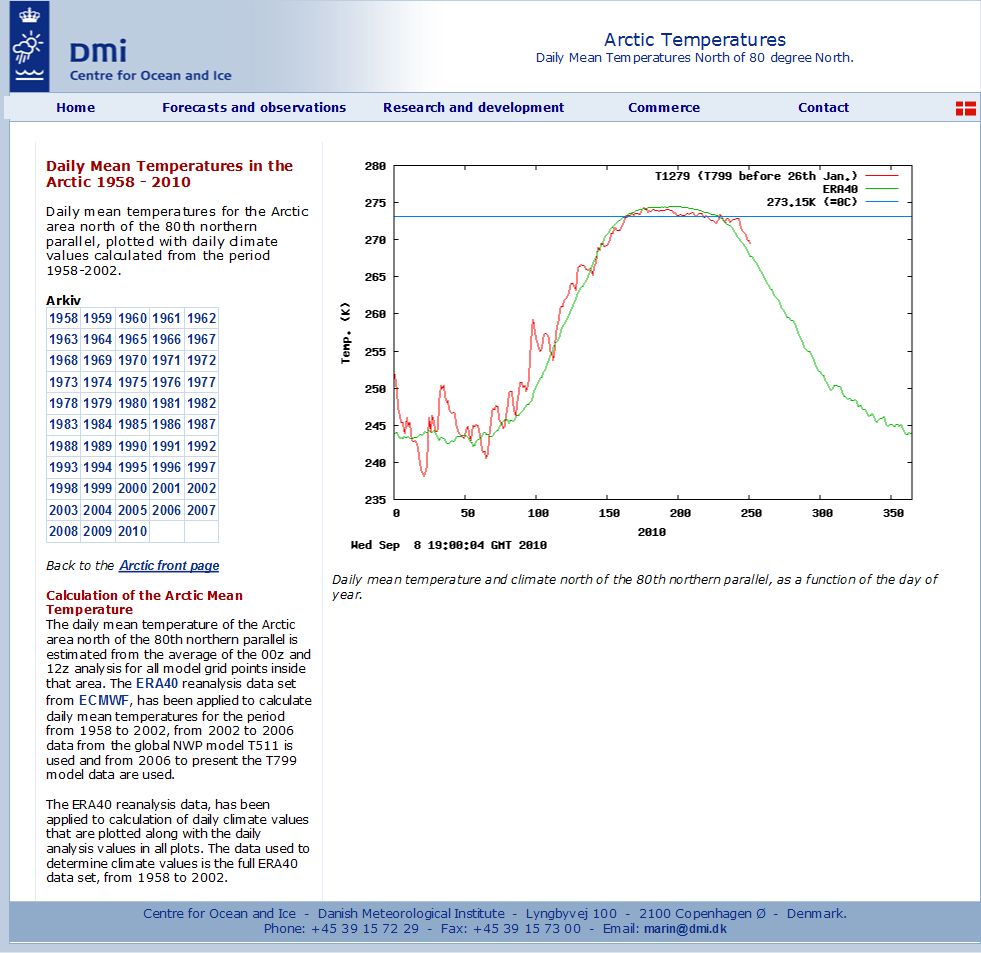
The summer of 2010 was unusually cold, according to the Centre for Ocean and Ice at the Danish Meteorological Institute. For almost the entirety of the June to August period, mean daily temperatures were below the corresponding daily temperatures over the past half century during which the Centre has maintained records.

The cold progress of this past Arctic summer can be seen in the Centre’s graph, seen here. The red line – this year’s temperatures – falls below the green bell curve starting just before Day 150 (late May) of 2010, indicating that just about every day this last summer was colder than normal. The green bell curve represents the historical record — the temperatures that the Arctic has experienced since 1958.

Of even greater significance for those concerned about a melting of the Arctic ice, however, is the graph’s blue line, which indicates the freezing point of water. When the red line appears above the blue line, temperatures are above 0 degrees and ice will melt. As the graph shows, the unseasonably cold summer gave the Arctic a short melt season in 2010. With temperatures in September now plummeting, 2010 is unlikely to log any more melt days, and the Summer of 2010 will go down in the history books as yet another year in which the Arctic did not melt.

Lawrence Solomon is executive director of Energy Probe.

Lawrence Solomon, Financial Post, September 9, 2010


Posted in Climate Change | Leave a comment

Have you looked at your electricity bill lately?

Toby Barrett
The Tillsonburg News
September 8, 2010

Electricity bills are beginning to send shockwaves as ratepayers discuss the latest round of price hikes. Residents and businesses alike are being caught off guard.

Last April, we in Opposition cautioned that an Ontario Energy Board approved rate increase would lead to an annual $350- hike for the average Ontario hydro bill. Causing further concern is the fact that the increase could double once the province’s green energy subsidies are rolled out.

As Energy critic John Yakabuski noted, “It is reaching the point, not all at once but incrementally, just like a leaking faucet, that the sink is going to overflow.” Calls to my office indicate we’re all getting soaked.

What’s more concerning is that people are already seeing increases they can’t afford, and there are still more to come.

Since Spring the McGuinty government’s slate of electricity hikes include:

  • $5 per month on hydro bills by 2012 to pay for the $8 billion renewable energy plan,
  • 8 per cent for the HST
  • 15.7 per cent increase in 2011 and 9.8 per cent increase in 2012 from Hydro One
  • A 6.2 per cent increase from Ontario Power Generation.
  • a charge to help cover $53 million of the government’s conservation and green-energy program.

The Canadian Manufacturers and Exporters Association indicates things will only get worse, reporting power bills will grow by 6.7 to 8 per cent annually for the next five years. That means a household with a monthly bill of $130 today will be paying about $191 by 2015.

As former Executive Director of Energy Probe, Tom Adams put it recently, “You are going to get screwed, and it’s going to be painful.” Adams assigns much of the blame to Ontario’s Green Energy Act, calling government mandated generous payments for large green energy projects, “just outrageous.”

In acknowledging the unaffordable situation electricity rates are causing for residents, Energy Minister Brad Duguid admits government’s coal closure crusade and green energy goldrush shoulder much of the blame: “We know that these central investments in our electricity bills aren’t easy for Ontario families. We’re moving past dirty coal generation to a future of clean renewables….we recognize there is a cost to these measures.”

At payout rates of 80 cents per KWh for solar compared to about 6 cents per KWh for coal, even a first grader could tell that coal closure means rate hikes for the electricity user.

But Minister Duguid has no plan: “We’re in the process now of putting together our long-term energy plan. That will give us a better idea going forward as to what the more accurate cost estimates will be.”

While government crows about its reduction in coal use, the heatwave that has marked the summer of 2010 has seen Nanticoke’s coal burning units running full-tilt. Given that the province is still mired in an industry killing recession one wonders where the extra needed energy will come from if the economy turns around without any coal generators to rely upon.

As we stare down the barrel of McGuinty’s green energy gun, I join those across the province wondering if we can afford to buy government’s high-priced power.

Posted in Energy Probe News, Power Generation in Ontario | Leave a comment

Aldyen Donnelly: The environmental myth of carbon taxes

(Sept. 07, 2010) The myth that carbon/energy taxes translate into green goods-producing job growth is namely that, a myth. In fact, 100% of the incremental job growth in carbon/high energy tax policy-dominated nations has been in the public sector, as goods-producing jobs flee.

For this reason, every nation that introduced carbon taxes/high energy tax policies between 1990 and 1999 has since elected to directly or indirectly reduce their dependence on these highly regressive consumption taxes. The first illustration below shows you changes in goods producing and government jobs, as well as national GHG levels, among key nations.

Note that Canada is the only nation listed that has not realized an absolute reduction in goods-producing employment over the covered period.  While Canada’s government-to-goods-producing jobs ratio (the ratio showing how many government jobs each goods production job is required to support in each economy) has grown, Canada had the lowest rate of erosion in this key ratio among the listed countries. Only Canada and the Netherlands realized total employment increases (including public sector jobs) on track with population growth.

In this table, “goods producing” includes all jobs in forestry, agriculture, fishing, mining, manufacturing, energy production, public utilities and construction. “Public sector” means jobs that are directly, permanently and 100% financed from tax revenues—which is why only a portion of US health sector jobs are included in the “public sector” job count for the US.

A critical error in the economic modelling of GHG mitigation measures that has been completed by and for the NRTEE, Suzuki Foundation and TD Bank is that the models employed value a job in the public sector as equivalent to a job that is privately financed. The models and NRTEE reports forecast that the “put a price on carbon” policies they recommend will result in a shift in total Canadian employment from the private sector to public and rate-regulated industries and that no reduction or constraint in flow of private investment capital into Canada will occur as our shift to a public sector-dominated economy results.

That European tax models have resulted in an unhealthy economic shift should be most apparent to those of you who work in western Canada’s forest sector. Since 1990, much of the EU27’s value-adding forest economy has shut down and EU public rate-guaranteed utilities increasingly depend on wood pellet feedstock imports from Canada—BC, in particular.

Published European economic performance data clearly shows that policies that drive up public sector spending as a % of GDP drive out private capital investment. So the economic models on which these key policy promoters rely are unrealistic in a critical manner.

The second table below gives you a glimpse of Swedish employment trends and how they more-or-less correlate with Sweden’s introduction and then phasing out of its national income to energy tax shift.

Sweden shifted overall governments’ tax burden from income to energy consumption taxes over the period 1990-1992.  Between 1996 and 1998, Swedish officials started to examine the impact of the tax shift on employment trends.

Over that period, Sweden ruled that all energy consumed by power generators, oil refiners and other key value-adding businesses would be 100 exempt from the Swedish CO2, SO2 and NOx taxes. To see all EU nations’ environmental tax exemptions listed go here, the European Enviornmental Agency and OECD Economic instruments Database, scroll to the near-bottom of page and click on “Exemptions in Environmentally Related Taxes.”

The important net results of the introduction of significant industrial exemptions from Swedish environmental taxes include:

  • A significant but unsustainable shift of Sweden’s overall tax burden from the private sector to the public sector.  Private corporations pay income taxes but do not pay environmental, energy or VAT taxes. All public sector agencies, hospitals, universities, schools, etc. do not pay income taxes but pay all energy consumption and VAT taxes. So when the Swedish government financed reductions in income tax rates (and/or cancelled scheduled increases in income tax rates) with revenues from new energy consumption and VAT taxes, that government shifted tax burden from the private to the public sector. In order to absorb the new tax burden, government agencies and publicly-funded institutions had to cut services and increase service fees.  The net result was that mandatory health care and social insurance premiums and payroll taxes increased at more than 5 times the rate of increase in posted (but not always collected) energy tax rates.
  • Over 2000 to 2003, Sweden went further to offer exemptions from all energy taxes (not just environmental taxes, but including excise taxes and all duties) to any “energy intensive business” that could maintain sales while passing tax costs through to customers, where an “energy intensive business” is deemed to be any business for whom the costs of energy (fuel and electricity) combine to account for 3% or more of production costs.
  • After Sweden introduced environmental and energy tax exemptions for key energy-intensive industries were in full effect (by 2002), the goods-producing jobs count in Sweden slowly started to recover.

Note that total employment in Sweden, including all private and public sector jobs, declined absolutely from 1990 through 1999 and did not recover to 1990 levels until 2007.

I am an ardent advocate for GHG regulation in Canada and the incorporation of market measures in that regulation. But consumption and production taxes and quota-based supply management (“cap and trade”) are not among the proved policies I recommend for BC, Alberta or Canada.

Whenever we have been serious about fair and efficient achievement of an environmental, health or safety objective, we have most efficiently achieved that objective with product standards, not consumption taxes or production limitations.

The key to efficient product standards is that government neither: (1) sets price or (2) designs the new products required to comply with our new product standards. Efficient product standards leave it to the market to compete on price and innovation. Consumption taxes and quota-based supply management regimes stifle innovation, limit the return on competition and the latter (the quota-based supply management regime) delivers massive new market power to traditional market incumbents at the expense of innovative new market entrants or incumbents who wish to and are able to innovate.

Unfortunately, all of the economic models that have been employed by the BC government and the NRTEE, to date, to evaluate different GHG management policy options treat production taxes, consumption taxes, quota-based supply management and product standards as identical economic measures.  In this regard, the academic modelers err gravely.

Aldyen Donnelly, September 7, 2010

Posted in Aldyen Donnelly | Leave a comment

A line in the sand: wind power’s ill effects

Two academics from the same university stand on either side of the divide on whether wind farms have negative health effects. According to a recent report, the two professors—Dr. Bob McMurtry, dean of the medical school at the University of Western Ontario from 1992 to 1999 and Dr. David Colby, an associate professor and medical officer of health in Chatham-Kent—are likely to be witnesses on opposing sides in a potential landmark case in Ontario’s Edward County challenging the province’s ambitious and controversial Green Energy Act.

Dr. McMurtry, who believes wind farms may bring with them health drawbacks for those living in their vicinity, says both pollution and climate-change could be easily addressed without building wind farms. He’s calling on the province—if it does move ahead with its wind energy plans—to spend $1 million on research to determine how far back turbines need to be to safeguard health.

Current regulations call for a 550-metre setback, but he believes a two-kilometre buffer is needed.

Dr. Colby, on the other hand, reviewed numerous studies on wind turbines, both for the Chatham-Kent council, and later for the wind power associations, and said peer-reviewed studies show no link between ailments and turbines—except for a small number of people upset by the turbines that then created stress, which could be the cause for some of the symptoms.

And though it may appear that the debate on wind turbines is academic, that’s certainly not the case. Opposition to wind turbines has been fierce across the province in proposed sites.

That opposition may become even fiercer as the Ontario government continues to offer handsome subsidies to wind energy developers in the effort to shut down the province’s coal plants and “green” its image. One report says the Ontario government has, “given its blessing to a wind industry that may build $20 billion worth of turbines across the province and in its lakes.”

Energy Probe is a keen supporter of renewable energy. We believe renewable energy has the ability to diversify our electricity supply, while allowing for more decentralized sources of power for consumers. But we’re not in favour of throwing massive subsides at forms of energy that are not technically or economically feasible.

Read the previous gangrene economy report, "Organized Crime Greasing The Wheels Of Europe’s Wind Industry" here.

Posted in Uncategorized | Leave a comment

Aldyen Donnelly: The expensive (Ontario) way to reduce emissions

(Sept. 1, 2010) The Ontario government’s plan to turn off coal and switch to biomass at the Atikokan Generation Station is a VERY expensive way to reduce Greenhouse Gas (GHG) emissions.

I am all for the generation of electricity from biomass/pellets. But EVERY European biomass-fired and co-fired electricity generation unit also produces a significant amount of heat (steam and/or hot water) that is supplied into a district heating system.

It is the co-generation of heat that makes the numbers work.

60% of Danish residential and commercial space and water heating is supplied through a hot water distribution system. 80% of the hot water in Denmark’s district heating system originates at old power plants that are co-fired with coal and wood pellets.

Atikokan is too far away from any sizable community to be a cost-effective district heat supplier. This is the wrong plant to convert to biomass. A major modification to accommodate biomass feedstocks at the Thunder Bay power station potentially makes MUCH more sense.

When you operate those boilers to generate electricity, they are working at a 30% to 40% (max) efficiency rate—lower if you’re burning biomass, nearer the high end if you are burning coal. When you co-generate useful heat at the same boilers, you are cranking up the efficiency rate (BTUs of energy in for BTUs of useful energy out) to 75% to 90% (depending on technology and fuel), even if the boilers are quite old.

It is only when you are switching to biomass AND cogenerating marketable heat—best bet in Ontario is hot water for district heat, as opposed to steam, which can be cost-effectively moved over distances up to 55 km. Building hot water transmission capacity is typically significantly less expensive than building incremental capacity to transmit electricity.

The role of district heat—and the role of old coal-fired power plants in the supply of hot water for district heating networks—in a national energy efficiency and GHG reduction strategy is well understood in both Europe and the US. In fact, every US climate change bill that has passed 2nd reading or better since 2006 (including the Waxman-Markey bill which passed 3rd reading in the House) includes the following provisions, which are expressly intended to dissuade utilities from de-commissioning old coal-fired boilers if/when they are positioned to supply district heat.

From the Waxman-Markey climate change bill, passed by the House in 2009 (identical language appears in two subsequent Senate draft bills):

In Section 102, “Definitions”, the bill defines “utility units” (page 282) as follows:

`(54) UTILITY UNIT- The term `utility unit’ means a combustion device that, on January 1, 2009, or any date thereafter, is fossil fuel-fired and serves a generator that produces electricity for sale, unless such combustion device, during the 12-month period starting the later of January 1, 2009, or the commencement of commercial operation and each calendar year starting after such later date—

`(A) is part of an integrated cycle system that cogenerates steam and electricity during normal operation and that supplies one-third or less of its potential electric output capacity and 25 MW or less of electrical output for sale; or

`(B) combusts materials of which more than 95 percent is municipal solid waste on a heat input basis.

This definition is repeated in the definitions for Section 111 (starting page 283), which definitions apply to the allocation of GHG allowances as well as the emission caps and obligations to surrender allowances that apply under the law.  The wording in these sections explicitly states that the new obligations to cap emissions and surrender allowances applies ONLY to “utility units” and not to electricity generating units that are deemed not to be utility units.

In other words, the above definition of “utility unit” affects an exemption from the new cap and trade obligations for combustion devices that meet the criteria outlined in (A) or (B) above. By definition, this is a very significant incentive for US owners of existing coal-fired power generation units to cogenerate steam (which they may or may not condense into hot water) and use the combustion units to supply heat into a District Heating system in lieu of using those units primarily to make electricity.

I am worried that Ontario’s early GHG reduction projects will be so expensive the net result will be a loss of public support for further measures to reduce GHGs in the province. Instead of the FIT—where government both sets prices and picks technologies, with all of the related complications and inefficiencies—Ontario should put a legally binding Renewable Energy Standard (“RPS” or “RES”) in place (with the broadest possible definition of “renewable” and including building efficiency upgrade projects as renewable energy credit-earning and where 277.778 Pjs of biofuel sales equates to 1 MWh of renewable power sales).

Instead of picking specific power generation units to fire or co-fire biomass, the Province should incorporate an exemption from the RES for existing coal-fired generation units that are converted to co-generate district heat, and issue RECs to those units, where 10,000 lbs of steam-equivalent hot water equates to 1 MWh of renewable power and earns a REC—whether that steam is 100% generated from biomass or 30% biomass/70% steam.

Aldyen Donnelly, September 1, 2010

Posted in Aldyen Donnelly | Leave a comment