Bracing for a time of tumult

Deborah Yedlin
Calgary Herald
September 19, 2009

It was all Sturm and Drang at the Friday morning presentations at the Global Business Forum.

Participants were jolted awake by the comments made by author and journalist Gwynne Dyer, whose grim message was that the world is heating much faster than scientists anticipated. Without strong and swift action aimed at reversing the trend, said Dyer, the world faces an apocalyptic future of famine, unpredictable weather patterns and drought. And these were just a few of the highlights.

It was enough to have everyone bolting from the room in search of a stiff drink.

But it didn’t end there.

The panel discussion following Dyer’s bleak pronouncements, not to mention Karen A. Harbert’s address over lunch, offered only more uncertainty. Harbert, president and chief executive of the Institute for 21st Century Energy, painted a depressing picture of the situation south of the border on climate change legislation, along with other energy-related initiatives that could act as disincentives for private-sector investment.

The lack of consensus on both the impact of and solutions surrounding climate change recalled an old joke that if all the economists were joined, end to end, around the world, they still wouldn’t reach a conclusion. The same appears to be true in the realm of climate change.

The only area where there was some form of agreement was that, in fact, the climate is changing, but the debate rages on as to the cause. The world, as scientists have been pointing out, goes through heating and cooling cycles over 100,000-year periods. The unanswered question is whether global warming today is part of this normal cycle or the result of human activity that has seen world’s population triple in the postwar period.
The fact the debate continues to be fragmented suggests that if there were expectations the December climate change conference in Copenhagen might reach a consensus on setting emissions targets and how to achieve them, that they should be set aside.

One of the issues, pointed out by Janet Peace of the Pew Centre on Global Climate Change and author Laurence Solomon, is that the U. S. is unlikely to pass its climate legislation before the end of the year because of the administration’s preoccupation with health-care reform. Without the United States –which accounts for 25 per cent of global emissions –arriving in Copenhagen with a firm plan on how to deal with climate change at home, the conference will fail to achieve its objectives.

While most people are notionally aware of the impact of higher temperatures around the globe, the fact that Australia is entering its eighth year of drought and that the polar ice cap is not as big as it was a few years ago, the biggest bombshell of the morning arguably came from one of the energy sector players.

TransCanada Corp.

chief executive Hal Kvisle poked some very big holes in the solution du jour for reducing greenhouse gas emissions: carbon capture and storage.

In short order, Kvisle painted a picture of the scale and cost of carbon capture and storage facilities. To store the carbon dioxide generated by a 500-megawatt plant, a reservoir the size of a 20-storey building is needed. If 6,400 of Alberta’s 8,000-plus megawatts come from coal-fired electricity, a lot of big reservoirs need to be found.

But that’s not all.

Retrofitting existing coal plants to capture carbon dioxide, especially the older ones, doesn’t make sense, either. Not only does it reduce the amount of available electricity because of what is needed to power the carbon capture and storage component, it’s not cheap.

In his view, the new plants at Genesee and Keephills that are relatively new are worth investing in–but the numbers don’t make sense for the others that are on either side of a decade from being decommissioned.

The take-away from all this is that the era of cheap energy is over. Much has been said and written about this in the context of transportation and fuel costs, but electricity is soon to get more expensive. Even if new plants are built with the ability to capture and store CO2 at the source, the cost per megawatt hour is more than double what it is today. Other options –such as nuclear–are even more expensive; it might be cleaner but the regulatory hurdles are so high that it remains questionable whether a new facility will be built in the next decade anywhere in North America.

Natural gas, which is often viewed as the bridge fuel to the future and would go a long way to addressing the emissions issue in the U. S., generates electricity at a price that works out to about five times the prevailing natural price.

One of the problems with natural gas-fired power is the inherent volatility in natural gas pricing; there have been a number of such power plants built in the U. S., but because the economics don’t work above a certain natural gas price, these are effectively sitting idle.

What was apparent in all the discussions was that addressing climate change is not a zero-sum game. And there is no such thing as a magic bullet. The world, as has been pointed out by Cambridge Energy Research Associates, is poised for a structural change in how it uses energy not seen since the 1970s.

The journey is clearly just beginning.

Posted in Climate Change, Costs, Benefits and Risks, Energy Probe News | 1 Comment

Aldyen Donnelly: Attacking Alberta’s oil sands reeks of hypocrisy

Before I talk about the oil sands, I would like to describe how the UK and European "Cap and Trade" allocations have been subsidizing European oil-producer GHG increases by hitting residential electricity consumers with substantial rate increases

UK and European cap and trade quota allocations transparently over-allocate free EU CO2 allowances to all oil and gas producers, while under-allocating free allowances to electric utilities. This procedure obliges electric utilities to buy surplus allowances from oil and gas producers to achieve compliance with their obligations to surrender CO2 allowances covering 100% of their GHG emissions at the end of every operating year. 

I should note that an EU law that was unanimously passed (with the UK’s strong support) in 2003 also exempts any business (read: oil refiner) for whom fuel and power purchases represent 3% or more of operating costs from ALL ENERGY TAXES—including excises, duties, CO2, NOx, SO2 and VAT).

What is the end result? You can read it in the BP, Shell, Total and other European oil producers’ Carbon Disclosure Project (CDP) disclosures.

From BP’s most recent disclosure to the CDP, and BP’s most recent annual report, we see that:

  • BP’s reported and regulated European GHGs per barrel of oil equivalent (BOE) production of European crude oil and natural gas has fallen substantially since 2005, from 469 BOE to 309 BOE.
  • Oil’s share of total oil and gas production has increased over the period.
  • BP’s reported and regulated GHGs per BOE grew from 0.076 TCO2e to 0.164 TCO2e from 2005 to 2008.
  • EU nations’ free allocations of CO2 allowances to BP increased from 0.080 TCO2e to 0.162 TCO2e per BOE between 2005 and 2008 and increased again in 2009 over 2008.
  • If BP maintains GHGs at 2007 actual levels from 2008 through 2012, BP will enter the 2013 post-Kyoto budget period with 963,478 surplus free CO2 allowances in the bank.
  • Under EU ETS rules regulators will freely allocate almost 13 MM free CO2 allowances to BP, even if the production/output/sales volumes from BP’s European oil and gas production and refining operations continue to decline in the future at the rate they have declined over the past 5 years.


Analysis of comparable disclosures by Royal Dutch Shell, Total and other leading Europe-based integrated oil and gas companies show oil and gas production, emissions and allowance surplus trends that are roughly comparable to the BP trends illustrated in the table below.


What Even the US EPA and EIA’s official numbers say about Alberta Oilsands

While GHGs per barrel of oil extracted and upgraded from bitumen are about 15% higher, on average, than GHGs from conventional oil extraction, the GHGs/barrel from conventional oil production are going up, quite quickly, as the world relies on increasingly deep conventional crude oil reserves and the deeper we go the more energy it takes to get the oil out.  But GHGs per barrel of bitumen and heavy oil extracted and upgrades from the oilsands are declining, and have great potential for further decline (of course, I think forcing the operators to realize that potential on an accelerated schedule should be the focus of Canadian GHG oilsands regulations, not wiping oilsands development out.)

In some nations, GHGs per unit of extracted conventional oil are much higher than they are in Alberta’s oilsands. Most notably, the heavy oil produced in California (2/3 of all of the state’s onshore oil production) generates 15% higher GHGs/bbl than Alberta’s oilsands, on average. And GHGs/bbl of conventional oil produced in Nigeria, on which both the US and UK heavily relies for imports, are about 20% higher than Alberta’s oilsands.

Technically, if our governments were to (1) rule that any new Alberta oilsands output has to meet or beat the current "SAGD-Dilbit"(see definition below) wellhead to refinery gate GHG benchmark illustrated in the Jacobs Consultancy report for AERI and (2) substitute incremental Alberta oilsands heavy and synthetic crude exports to the US for US Nigerian imports and California’s heavy oil production: global GHGs associated with the US consumption of conventional gasoline derived from  450,000 bbls/year of new Alberta oilsands output could fall by some 2% to 3%.

If we were to ensure that all Alberta crude output is dedicated as a feedstock to refineries that are designed to maximize diesel/distillate—as opposed to gasoline—production as a fraction of total products, the global GHGs associated with this theoretical 450,000 bbls/year increase in oilsands exports to the US would fall even more. If the diesel produced from Alberta’s heavier feedstocks in diesel-oriented refineries was sold to consumers who retire gasoline-powered cars and replace them with 2009 and later-model diesel-powered cars, the global GHGs associated with that 450,000 bbl substitution could reach 25%, at a low cost relative to other transportation sector GHG reduction strategies.  If the diesel made from incremental Alberta heavy crude feedstocks is refined in plants designed to max out the diesel/distillate fraction, blended with 20% biodiesel before it is sold, the GHG reduction associated with that 450,000 bbl/year increase in Alberta oilsands crude and upgraded exports to the US could reach or exceed 40%.

To erect an artificial barrier to Alberta crude exports, largely with a view to protecting California heavy oil producers and California’s 20 gasoline-oriented refineries, all proposed US GHG regulations preclude the substitution of diesel for gasoline sales and do not permit market participants to take credit for the substantial and real GHG reductions that derive from that substitution.

Of course, the GHG reduction potential associated with the diesel-for-gasoline substitution is well-recognized in the UK and Europe.  Total transportation fuel consumption (in total gigajoules or "Gjs" of energy) actually grew faster in the EU25 than in Canada from 1990 through 2007. 100% of the transport sector GHG reductions logged by the UK and Europe since 1990 derive from the substitution of diesel for gasoline. At this time, 40% of on-road European passenger vehicles are diesel-powered and over 60% of new passenger vehicles sales are diesel-fuelled models—even in the UK.

Given these facts and those outlined below, the British Bank’s Alberta Oilsands protest is the height of hypocrisy..

Detailed Explanation and Data and Pictures you might find helpful: US Oil Production and Trade

From 2003 through 2008 the US imported an average of 330,000 barrels of oil from Nigeria and California heavy oil output averaged about 120,00 bbls/year of which US heavy oil imports from Canada’s oilsands reached 461,000 bbls in 2008.

A range of different extraction, upgrading and product export configurations can be and are implemented in Alberta’s oilsands. Global GHGs associated with US conventional and reformulated gasoline consumption would go down if we substituted the Alberta oilsands feedstock produced in the existing "SAGD-Dilbit" configuration, using existing technology and common practices (explained below) for Nigerian crude ("Bonny Light" in the table below) imports and California heavy oil ("CA-TEOR" in the table below).  The GHG reduction per barrel of gasoline produced would be small in the Nigerian crude substitution case, and as much as 10% if the Alberta exports are substituted for California heavy crude oil.

This means that if final US GHG and fuel regulations are designed to have environmental integrity (neither the California Low Carbon Fuel Standard nor the Binagaman-Specter or Waxman-Markey bills have environmental integrity), and if all incremental Alberta oilsands output achieved or beat the "SAGD Dilbit" configuration GHG emission benchmark, then there is the potential to increase Alberta oilsands exports to the US by up to 450,000 bbls/year with a net reduction in the global GHGs associated with those exports of 2% – 3%.

Of course, if Canadian regulators push Alberta oilsands producers to adopt known methods to further cut GHG discharges, the potential for global GHG reduction through the substitution of Alberta exports for Nigerian imports and California heavy oil is even greater.

Comparing Wellhead to Refinery Gate GHGs by Crude Feedstock, for Gasoline vs. Diesel

The above analysis is based on the assumption that all refineries are designed to convert 35% of each barrel of refinery feedstock, on average, into gasoline.  Making gasoline from Alberta feedstocks can add up to 20% to the GHGs/bbl of gasoline output, and all refineries designed to maximize gasoline output per barrel of crude input discharge, on average, 15% more GHGs per barrel of product output than refineries designed to maximize diesel output.

 If 100% of Alberta feedstocks were to be directed to refineries that are designed to maximize diesel output (this scenario is not analyzed in the Jacobs Consultancy report), the wellhead to refinery gate GHGs/Gj of diesel produced would be about 15% lower than the GHGs/Gj of gasoline produced in the SAGD-Dilbit configuration in the Jacobs estimates.  If Alberta oilsands feedstocks are dedicated to diesel production, therefore, life cycle GHGs (GHGs/Gj of marketable product) would compete with or improve on all of the gasoline GHG estimates appearing in the Jacobs estimates.

Therefore, the single most important message in the Jacobs analysis is that:

  • Canadian regulators should see/incent the market to see Alberta heavy and synthetic oils as diesel feedstocks, and
  • A low cost way for the US to reduce reliance on oil imports AND cut transportation sector GHGs is to implement policies that encourage the US and Canadian consumers to replace gasoline-powered passenger vehicles with ultra-low sulphur/biodiesel blended fuels that are made from Alberta heavy and synthetic crudes.

Comparing Refinery GHGs for Gasoline and Diesel Production

In the refinery, US average GHGs to produce diesel fuel are, on average and over all crude feedstocks, 9% lower than refinery GHGs associated with the production of conventional gasoline averaged over all US conventional and unconventional crude and synthetic crude feedstocks. But one of the reasons upstream Alberta bitumen and heavy oil is so GHG intensive is that many (not all) Alberta heavy oil producers remove all of the sulphur from the crude in the upgrading process. 

In the US, most of the conventional crude oil that arrives at a refinery gate still contains sulphur that has to be removed by the refiner.  This requirement to remove sulphur from conventional crudes at the refining stage is part of the reason that GHGs for refineries designed to max out gasoline production are higher than GHGs for refineries that are designed to max out diesel—and use Alberta feedstocks to do so.

Also, most refineris that target a 35% gasoline fraction averaged over all outputs have to subject all feedstocks to extra processing (such as "hydro-cracking", which consumes energy and generates GHGs) to achieve that high gasoline fraction from both the conventional and heavier-than-conventional feedstocks. 

The best light sweet crude feedstocks typically produce a 22% to 25% gasoline and Alberta heavy crudes produce only an 8% to 12% fraction without extra processing.  The extra processing converts diesel/distillate fractions into lighter gasoline fractions.

If North American fuel and climate change regulations recognize that full life cycle (including tailpipe, which are not included in the table above) GHGs for diesel are significantly lower than lifecycle GHGs for gasoline, then a low cost North American GHG reduction strategy involves the processing of Alberta heavy crude in refineries that are designed to maximize the ultra low diesel fraction—not the gasoline fraction—and to allow the North American gasoline market to slowly shift to ultra low sulphur diesel-biodiesel blended fuels.

Ironically, these facts are well recognized in the UK, where 60% of new passenger vehicle sales are diesel models. All European new diesel passenger vehicles are fitted with catalytic converters and fine particulate traps to massively cut diesel pollution.  These cheap tailpipe pollution control measures were not viable in North America before 2007, because they require ultra low sulphur diesel that was not generally available in North America before November 2007.

Posted in Aldyen Donnelly | Leave a comment

Endless oil

Lawrence Solomon
Financial Post
September 12, 2009

Russian research has shown that the Earth doesn’t need dinosaurs to produce oil.

Do dead dinosaurs fuel our cars? The assumption that they do, along with other dead matter thought to have formed what are known as fossil fuels, has been an article of faith for centuries. Our geologists are taught fossil fuel theory in our schools; our energy companies search for fossil fuels by divining where the dinosaurs lay down and died. Sooner or later, we will run out of liquefied dinosaurs and be forced to turn to either nuclear or renewable fuels, virtually everyone believes.


Except in Russia and Ukraine. What is to us a matter of scientific certainty is by no means accepted there. Many Russians and Ukrainians — no slouches in the hard sciences — have since the 1950s held that oil does not come exclusively, or even partly, from dinosaurs but is formed below the Earth’s 25-mile deep crust. This theory — first espoused in 1877 by Dmitri Mendeleev, who also developed the periodic table — was rejected by geologists of the day because he postulated that the Earth’s crust had deep faults, an idea then considered absurd. Mendeleev wouldn’t be vindicated by his countrymen until after the Second World War when the then-Soviet Union, shut out of the Middle East and with scant petroleum reserves of its own, embarked on a crash program to develop a petroleum industry that would allow it to fend off the military and economic challenges posed by the West.

Today, Russians laugh at our peak oil theories as they explore, and find, the bounty in the bowels of the Earth. Russia’s reserves have been climbing steadily — according to BP’s annual survey, they stood at 45 billion barrels in 2001, 69 billion barrels in 2004, and 80 billion barrels of late, making Russia an oil superpower that this year produced more oil than Saudi Arabia. Some oil auditing firms estimate Russia’s reserves at up to 200 billion barrels. Despite Russia’s success in exploration, most of those in the west who have known about the Russian-Ukrainian theories have dismissed them as beyond the Pale. This week, the Russian Pale can be found awfully close to home.

In a study published in Nature Geoscience, researchers from the Royal Institute of Technology (KTH) in Sweden and the Geophysical Laboratory of the Carnegie Institution of Washington joined colleagues at the Lomonosov Moscow State Academy of Fine Chemical Technology in publishing evidence that hydrocarbons can be produced 40 to 95 miles beneath the surface of the Earth. At these depths — in what’s known as Earth’s Upper Mantle — high temperatures and intense pressures combine to generate hydrocarbons. The hydrocarbons then migrate toward the surface of the Earth through fissures in the Earth’s crust, sometimes feeding existing pools of oil, sometimes creating entirely new ones. According to Sweden’s Royal Institute, “fossils of animals and plants are not necessary to generate raw oil and natural gas. This result is extremely radical as it means that it will be much easier to find these energy sources and that they may be located all over the world.”

The Institute’s lead author, Vladimir Kutcherov, Professor at the KTH Department of Energy Technology, is even more brash at the implications of his findings: “With the help of our research we even know where oil could be found in Sweden!” he delights. Kutcherov’s technique involves dividing the world into a fine-meshed grid that maps cracks (or migration channels) under the Earth’s crust, through which the hydrocarbons can bubble up to the surface. His advice: Drill where the cracks meet. Doing this, he predicts, will dramatically reduce the likelihood of dry wells. Kutcherov expects the success rate of drillers to more than triple, from 20% to 70%, saving billions in exploration costs while opening up vast new areas of the planet — most of which has never been deemed to have promise — to exploration.

The Nature study follows Kutcherov’s previous work, published in the Proceedings of the National Academy of Sciences, that created hydrocarbons out of water, calcium carbonate and iron — products in the Earth’s mantle. By superheating his ingredients in a pressure chamber at 30,000 times atmospheric pressure, simulating the conditions in the Earth’s mantle, Kutcherov’s alchemy converted 1.5% of his concoction into hydrocarbons — gases such as methane as well as components of heavier oils. The implication of this research, which suggests that hydrocarbons are continuously generated through natural processes? Petroleum is a sustainable resource that will last as long as Planet Earth.

lawrencesolomon@nextcity.com

Lawrence Solomon is executive director of Energy Probe and Urban Renaissance Institute and author of The Deniers: The world-renowned scientists who stood up against global warming hysteria, political persecution, and fraud.

Read the sources for this column. 

Posted in Energy Probe News, Fossil Fuels | 7 Comments

Aldyen Donnelly: The “Intensity” versus “Absolute” emissions target debate

If the Conservatives can get their Communications Machine working, the "Intensity" versus "Absolute" facility level cap on emissions would be a major loser for the Liberals as a campaign issue.

A cap and trade regime that has only absolute emission limits, established only through a quota allocation, delivers unprecedented market power to the highest emitting market incumbents at the expense of low emitters and market entrants.  While Quebec does not understand this yet, the case is easily made.  If the Liberalss make "absolute vs. intensity" a campaign issue and promote a quota auction-based mechanism to establish absolute limits, the Conservatives can KILL the Liberals in Quebec with a well-designed communications plan.

It Goes Like This 

The feds establish an absolutely fixed national Greenhouse Gas (GHG) quota supply.  They decide to auction 100% of the quota, every year. We had the first auction last Thursday. Imperial Oil secured triple the GHG allowance supply that they need to continue to operate Syncrude and their refineries on a Business as Usual (BaU) basis, but Hydro Quebec was outbid and comes home short of allowances. Hydro Quebec now has to buy allowances from American Electric Power (another company that was successful at the auction) and Imperial Oil to continue to operate the provincial utility’s highly efficient gas-fired power generation capacity. Cap and trade is dead on arrival.

Quebec cannot afford to stay in a Canada that imposes any national GHG quota regime and trading rule on the Provinces. Period. Quebec cannot afford to allow the feds the right to auction quota, even if the feds promise to transfer all auction funds to the Province in which successful bidders are located.

And Quebec needs any federal standards to be intensity-based.  If the Quebec legislature was operating rationally, its members would threaten to constitutionally challenge any federal regulation that imposes absolute GHG limits at the facility level. While the Quebec legislature is not operating rationally now, federal politicians can speed them up the learning curve by walking around the province with the "plant list".

The feds can assign intensity limits to sectors and facilities and can only make any combination of those limits acceptable to provinces if:

  • Provinces have the discretion but not the obligation to assign absolute limits to the same facilities and
  • Provinces have the discretion to assign different intensity limits than the feds prescribe under the condition they can demonstrate that it is reasonable to forecast that the Province’s proposed allocation of limits/entitlements will achieve reductions, over time, comparable to those that would be achieved through direct implementation of the federal formulae.

This is hard stuff to work through in hypothetical contexts. But all federal politicians need to do is campaign through Quebec and southern Ontario with the major emitters’ plant lists in their hands, pointing out the implications of any Liberal cap and trade or carbon tax proposal for individual plants and ridings.

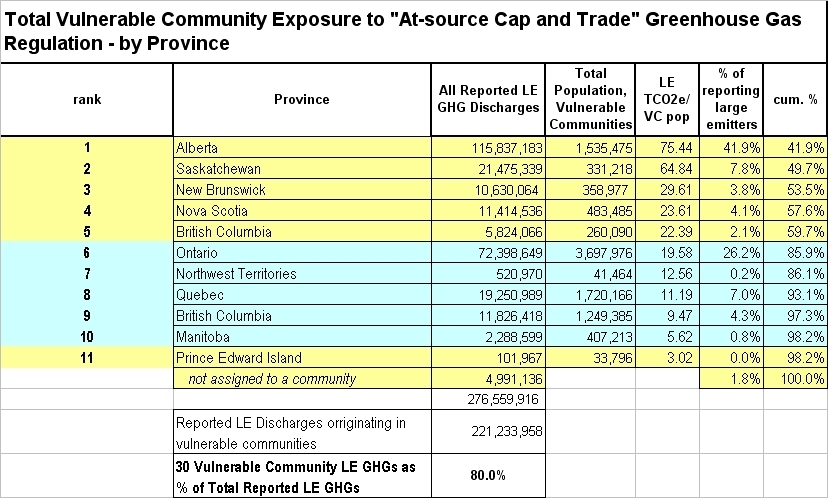
If I define "community" as a federal riding, and a "vulnerable community" as one where a dominant proportion of the voting age population relies on a large emitting source for direct and indirect income, the Large Emitter’s plant list tells us that "cap and trade" and/or carbon tax vulnerable communities are distributed, by province, as in the following table.  While Ontario and Quebec only rank 6 and 8 on the province list, look at the sizes of the vulnerable voting age populations for those provinces, compared to the populations whose employment is at risk in the west. Note: LE TCO2e/VC pop" in the heading for column 5 below means "Large Emitter GHGs per registered voter in climate change regulation vulnerable communities.   


Specifically, the 30 ridings most economically vulnerable to quota-based GHG management and market control are as follows.  This looks to me like 10 Liberal seats that the Cons can win back with an informed campaign. However, I don’t see many Conservative seats open to Liberal acquisition on this same list.  Don’t know if either of the Liberals or Conservatives are on top of this, but if the Liberals are on top of this they would just be stupid to bet that the Cons are not.


When we get past the high level rhetoric and down to the facts of the matter, the Canadian operations of 10 corporate entities account for 52% of reported Large Industrial Emitters’ GHGs and only 25 corporate entities account for 76% of reported facility level GHGs. Any serious GHG management plan has to look specifically at the circumstances and development plans of these corporate entities (perhaps in the way that Massachusetts law does for its large emitters) and make sure that any rules we promulgate are both fair to these asset owners and other Canadians and will result in physical changes in the plants these companies operate.  

Note that this is not a west-only list.  There is not enough GHG inventory left for these corporations to comply through offset purchases for the next 10 years.  If we build a GHG regulatory structure that affords them such an opportunity it is, by definition, a regulatory structure that will fail to cut Canadian GHGs, absolutely, by at least 17% by 2020.  And if we fail to implement a regulatory strategy that can be reasonably forecast to deliver such an outcome, as soon as such a finding is published by the US EPA then all Canadian energy, building product and food exports will be vulnerable to US , European, Japanese and South Korean tariffs.

I should note that this list reflects GHG reporting only for facilities that discharge more than 100,000 TCO2e per year.  However, when we reduce the reporting threshold to, say, 10,000 TCO2re/year (the US EPA-proposed reporting threshold) there are only small ranking changes in the following list, because all of the operators of the largest emitting facilities own plants that are captured by the lower reporting threshold.  There are also only small ranking changes in the vulnerable community list.  If anything, Ontario and Quebec (along with BC) communities rank higher in vulnerability when we lower the reporting threshold.


Driving down to local detail

When we drive down to narrower definitions of "community", we identify more extreme GHG regulatory risk differentials. As noted above, I used federal electoral ridings to identify "communities as risk" in the above tables.  What happens when I shift the definition of "community" to smaller provincial electoral ridings?  (I think ridings or economic development regions are better definitions of "community" than metro areas because many people cross metro areas for work.  In rural Canada, over 60% of workers leave their metro area for work every day, but most rural Canadians work within their provincial electoral area.)


Now, back to "intensity" versus "absolute"

Every "Successful Cap and Trade" Regime Uses Intensity Limits to Drive the Reduction Schedule

Every existing and relatively "successful cap and trade regulation" in US history assigns at least 2 limits to regulated sources: an absolute limit and an intensity limit. The first intensity limits in existing US regulations are defined in emissions/MM BTU heat input terms  Then, in many but not all cases, the facilities’ operating permits include additional limits: emissions/unit of output, emissions/hour of operation, etc. One of the reasons that the EU CO2 ETS is such a failure is that EU rule-makers failed to grasp this most important aspect of US cap and trade.

In the EU rule-makers’ defense, part of the problem is that a good percentage of the US "experts" on "cap and trade" are policy wonks who have never, ever looked at a US operating permit. In the US regulatory system, the legally binding facility limits are embedded in permits. Everything is embedded in permits, if the regulation is enabled by the US Clean Air Act. Permit administration and SO2/NOx market administration are in two different and unconnected locations in the US EPA.   

It surprised me to learn, in the late 1990s, that many of the NRDC, Pew and other lobbyists had never looked at or considered the implications of the terms and conditions in operating permits and were only familiar with the administration of the allowance market system. But when the US Congress approved the Acid Rain cap and trade rule, the first specification they wrote was a requirement that affected facility operators apply for permit amendments. If it does not say in your permit that you have to hold allowances, you don’t have to hold allowances. The fact that you now have to hold allowances does not eliminate your obligation to comply with the operating limits outlined in the permit.

In every existing case, the regulated facilities shall not exceed any of the binding emission limits. Most (but not all of the time) the emissions/MM BTU heat input limit is the reduction driver, and the absolute limit equates, roughly, to the estimate of facility emissions after an equipment failure at the beginning of a permit term. (Since the intensity limit can decline over the permit term, the absolute limit embedded in the permit can be 30%+ higher than the intensity-based maximum allowable emissions by the end of a 12 to 16 year permit term). In the US electricity market, in most states the operators also must comply with sulphur content limits (which are intensity-based) for the coal they take into their plants.

Every generating unit that is covered by the US Acid Rain Program includes multiple limits, and no operator can exceed any one of the permitted limits no matter how many SO2 allowances they might have in the bank.

It is not possible to build a cap and trade regime with any environmental integrity without intensity limits. That is why I have always been very shocked at the Canadian ENGO community’s opposition to intensity targets. The ENGO community erred in a big way when they launched the PR campaign that pits intensity against absolute targets. All along, they should have argued intensity AND absolute targets are necessary.  They would know this if they actually read any of the over 40 existing cap and trade rules operating in the US air, water and wastewater markets, all of which have both limits.

Because the intensity limits define the emission reduction schedule, it is essential to prescribe the intensity limits first. I might be proved wrong, but I think that Environment Canada officials now understand that it is essential to incorporate intensity limits in any regulation in development. It is essential that our regulatory go back and develop intensity limits to make any Canadian "cap and trade" proposal work. But I do not perceive they are talking about intensity limits and no absolute limits.  They are (or at least should be) talking about both, where the absolute limits are slightly higher than and derive from the intensity limits.

The annual absolute emission limits that are included in US facility operating limits are overall market governing limits. While facility operators focus on the generally more stringent intensity limits for operating purposes, regulators know that the maximum aggregate discharge from the regulated sources will not exceed the sum of the absolute limits. Actual aggregate emissions are almost always about 15% below the sum of the absolute limits in these markets, because the regulated entities will only use their absolute annual limits for short operating periods while they are addressing equipment breakdowns.

Why Are Intensity Limits So Important?

"Cap and Trade" is a simple quota-based supply management.  It works just like dairy or chicken quota or municipal taxi license regimes. In every other existing Canadian (and long-standing global) quota-based supply management market, it is most often the case that 100% of the quota is auctioned.  But only entities with "quota licenses" are permitted to participate in the auction. Only entities that actively operate dairy farms, for example, qualify to have dairy quota licenses.

Among other things, the auction rules also only permit each license-holder to bid one price at each quota auction—none of this multiple cascading bid stuff that you see in RGGI or the US SO2 auction.  In the dairy market, licensees pay the price they bid for quota, while in most emission markets—as in electricity markets—all successful bidders pay the same price the last winning bidder pays for quota.

When you elect to build a market where every bidder pays the lowest successful bid price, and you allow every market participant to make multiple bids, you inevitably deliver market power to the parties with the most cash-flow—potentially at the expense of the parties most likely to bring innovation to the market.  The richest parties then hoard their quota (only "leasing "quota through swaps) to block new entrants. The badly designed quota regime enables them to drive market prices up while eliminating new market entrants. Inevitably, governments have to follow-up their introduction of quota-trading regimes with (1) border tariffs blocking lower cost imports and (2) price controls to mitigate the market power of the quota holders.

The US SO2 and Los Angeles RECLAIM market designers clearly understood these issues. The designers of these two quota markets used different approaches to mitigate them, and the difference in outcomes is worth paying attention to.

Acid Rain/ SO2 Market: Gettting it Wrong

The EPA designers of the SO2 market decided it was essential to maintain the binding intensity limits in cap-covered generation unit operating permits as a means to limit the market power of incumbent quota holders. If no facility operator can exceed their permit-based intensity limits, the designers believed, they had adequately limited the financial gains to market incumbents from quota banking and hoarding. They were wrong, however.  

Under the Acid Rain rule, starting in 2000 every developer of a new power generation unit gets NO free allocation of SO2 quota (the 110 oldest US generating units still receive just under 5 million free SO2 allowances each year through 2030), and they are obliged to buy SO2 allowances from the market or government auction to cover 100% of their new plant SO2 emissions—even though the new plants discharge, on average, about 10% the SO2/MWh that the 110 oldest plants are permitted to discharge.

In fact, the owners of the 110 oldest generation units in the US received their free SO2 allowanced entitlement for a 30 to 35 year term even after they permanently shut down the unit to which the allowances were first allocated. If you go through the US SO2 market data, you will see that since 2000, no market incumbent corporation has sold SO2 allowances to any new market entrant. The incumbents control what new plants get built, through their allowance management practices. The apparent "market price" of SO2 allowances is irrelevant to US utilities. That they can hoard their allowances to block new entrants is most important.

Most brokers argue that the quota instrument and ex-ante annual deposits of quota in plant accounts is necessary to give the market the certainty they require regarding quota supply. This is complete bunk. If you go to review the allowance holdings report, you can look up the free US SO2 allowance entitlement by plant, by year, through 2039. Without any quota, the SO2 regulation that is reflected in this allowance entitlement table provides more certainty regarding future supply than exists in any physical commodity market (especially given that the SO2 rule stipulates that entities that shut down plants still receive the listed SO2 allowances after the shut down). The information at this site also means that new market entrants can easily identify allowance holders without the help of brokers.

In theory, new market entrants can get SO2 allowances at the annual EPA SO2 auction, either directly or through brokers. But if you look up the auction results for many years, you see that incumbents (and brokers acting for incumbents) tend to clean up at the auction. The only good thing about the Acid Rain allowance auction is that bidders pay the price they bid for the allowances they take home from the auction. This is not how traditional electricity markets or the RGGI auction works.  

We should never, in Canada, implement any auction that is modeled after the RGGI design. In RGGI, every bidder pays the lowest successful bid price for all of the allowances they take home.  So bid prices simply create a distribution ranking. Operators of old, written-off coal plants can bid very high prices to stake out high rankings for large bids without any risk that they have to pay that price for allowances. Operators of new, highly efficient and higher operating cost plants cannot afford to bid high allowance prices because that would run them into operating losses. So the system guarantees that the oldest, dirtiest plant operators get all the allowances they need at the highest price the most efficient cleanest operator can afford to pay.  

This is a very stupid system unless, of course, your only objective is to subsidize the continuing operation of the oldest, dirtiest plants. And this is happening.  Look at the age distribution of the oldest US plants that sold power in 2007 and 2008 in the table below.  The US Acid Rain program’s quota allocation and trading rules have actually extended the operating lives of the nation’s oldest and dirtiest plants while impeding investment in "clean coal" technology. This is, in fact, why the EPA felt the need to introduce the CAIR regulations in 2005 (which the US court vacated in 2007) and why Congress is taking a very different—even more "intensity-based" approach to "cap and trade" in the developing climate change legislation.

Posted in Aldyen Donnelly | Leave a comment

Aldyen Donnelly: Ontario and Quebec premiers need to study up on emissions targets

If the premiers of Ontario and Quebec come out swinging against a federal plant to hit the oil sands facilities with "intensity" targets while they hit manufacturing industries with absolute targets they will look very, very foolish in the not-to-distant future.  It is time to distinguish between what you need to rebuild your economies as provinces and anti-Conservative politicking (says she, a Lbieral).

The bottom line is that environmental non-governmental organizations (ENGO) have sold the media on the invalidity of intensity targets, so if your Premiers come out swinging you can probably score a hit on the federal Conservatives in the short term.  But the fact is that when emission limits are assigned to facilities, intensity limits are much harder to comply with than absolute limits, especially if the absolute limits are relative to operating emissions for the base year of, say, 2006 or 2007.  

The ENGO argument against intensity targets is valid only if those targets define national, province-wide or sectoral objectives. An intensity limit is always, by definition, an absolute limit when it is applied at the facility level, especially when it is coordinated with a stringent emission standard for new sources.  At the facility level, an operator cannot achieve compliance with an intensity limit simply by cutting back output. An intensity limit compels the operator to invest in equipment to cut back emissions per unit of output.  

In every existing Canadian federal and provincial pollution regulation, as well as every US cap and trade market, an existing facility is deemed a "new facility" if it applies for a permit amendment to increase emissions.  In other words, as long as the feds introduce a credible and stringent New Source Performance Standard (the most stringent limit which new facility developers have to comply) along with the emission limits for Existing Facilities, intensity-based facility limits are potentially much more difficult and costly to comply with than absolute facility limits.  I have not seen the federal regulatory proposal, but all public indications to date are that it will include a set of very stringent New Source Performance Standards.

As the output declines from facilities that have intensity-based emission limits, so do their overall effective entitlements/rights to emit.  On the other hand, if a facility operator is assigned an absolute emission limit, they can simply cut back output to comply.  If that absolute limit is defined as a % reduction relative to, say, 2006 actual emissions levels, virtually every manufacturer in Ontario is already at least part way to compliance given the reduction in product output they have experienced due to the recession.

As you know, I continue to remind anyone who asks that every existing long-standing cap and trade regime has assigned BOTH intensity and absolute limits to all of the facilities covered by the cap—including the US Acid Rain program SO2 market rule. In 39 out of the 40 existing precedents, the intensity limits drive the emission reduction agenda, not the absolute limits.  

If your objective is to cut emissions, you define the intensity limits first.  If your objective is to allocate quota on the basis of historical market share, you assign absolute limits first.  Remember, cap and trade is simply quota-based supply management and works just like Canada’s dairy quota regime.

If Ontario and Quebec are assigned absolute limits based on historical manufacturing sector emissions, that means the feds have decided (wrongly in my view) to ensure that Ontario and Quebec remain the manufacturing centres of Canada and will not have to compete with the rest of Canada for that status.  

Look at the dairy quota regime. Quebec is legally assigned 37% of Canada’s dairy quota, while BC gets only 4%, even though BC now houses 13% of the dairy-eating population.  Canada’s dairy market would be much more efficient if BC farmers were allowed to increase their output, but the national dairy quota regime put in place in the early 1970s—which based absolute production shares on historical market shares—sets the Quebec and maritime provinces’ shares of the national dairy market at historical levels.  Historically, those regions had larger shares of the national population and dairy demand.  So now BC consumers have to import dairy products from the eastern provinces due to the quota regime that set market shares in stone.

There are many, many reasons why assigning absolute emission limits to sectors and facilities that are defined as % reductions relative to historical CO2 levels to drive CO2 reductions—which usually means allocating CO2 discharge rights to provinces based on historical levels—is a very, very bad idea for Canada. Not the least of these is that any CO2 regulatory regime that evolves, structurally, into a mirror of Canada’s dairy quota regime will likely hasten the break up of the nation.  

In am likely to prove very concerned about the federal regulatory proposal if it, in fact, takes the shape that the media has suggested over the past days (and it may well do so…I don’t know). But it is well past time that your Premiers shifted from their rhetoric in these matters to understanding-based dialogue.

Assigning intensity limits to petroleum producers and absolute limits to manufacturers most likely gives the manufacturers the cost break in this deal, not the other way around as is suggested in the media.  If your Premiers come out shooting against intensity targets they could win a short term media war against the federal government, because the media clearly does not get this.  

But that short-term win will be entirely at the expense of your manufacturing economies in the medium and long terms.

Posted in Aldyen Donnelly | Leave a comment

Where's the skepticism?

Lawrence Solomon

September 8, 2009

Bjorn Lomborg, the skeptical environmentalist, has yet to apply his thinking to premises of climate change.

First assume that, on behalf of the global community, you must spend $250-billion a year on something that, while not entirely worthless, promises to give you almost no bang for the buck. Something that came 10th in a list of 10 global challenges.

Next, take on the task of finding the least-worst ways to spend that $250-billion.


Then, unveil your list of least bads, as well as the very baddest bads to government leaders, knowing that they think you have it all upside down — they view your lowest priorities as their highest, and your baddest bads as the bestest goods.

The “you” in this tale of masochism is Denmark’s Bjorn Lomborg, a.k.a. The Skeptical Environmentalist, and the “something” that came dead last in his list of 10 global challenges was climate change. In 2004, Lomborg and his Copenhagen Consensus Center asked a distinguished panel of economists to weigh the usefulness of stepping up action on 10 global challenges: civil conflicts; climate change; communicable diseases; education; financial stability; governance; hunger and malnutrition; migration; trade reform; and water and sanitation. He then asked his panel to answer the following question: “What would be the best ways of advancing global welfare, and particularly the welfare of developing countries, supposing that an additional $50-billion of resources were at governments’ disposal?”

The panel decided that the money could be best spent on new measures to prevent the spread of HIV/AIDS, where $27-billion could avert nearly 30 million new infections by 2010. A close second on the list of priorities was hunger and malnutrition, where a mere $12-billion spent on food supplements would work wonders reducing iron-deficiency anaemia.

Dead last on the panel’s list was climate change: No matter how the panel looked at the proposals on the table, it found no way to spend money intelligently to solve climate change, even though it accepted as given that climate change was a bona fide concern.

Government leaders, unimpressed, decided to press on with their plans to spend billions on their climate change priorities. So, Lomborg, in an attempt to minimize the damage they could do, decided to make the best of a bad bargain. He would again assemble a panel, this time accepting as given that $250-billion a year must be spent on climate change.

Yesterday, his new panel came out with recommendations for how governments can minimize the harm they’re planning to inflict on the globe in pursuit of alleviating harm from climate change. The least bad thing governments can do involves geo-engineering the planet, possibly by spraying salt water over the oceans at a cost of a mere $9-billion, in the process creating cloud cover that will help cool the Earth. To guard against the potential for inadvertently damaging the planet in the process, and to see if the spraying technology could actually work, it would be preceded by 10 years of research. The panel’s next least bad recommendation is R&D into carbon-free energy technologies that are immature, such as nuclear, fusion and geothermal.

Just about the worstest of the baddest ideas of all, the panel found, are exactly what attract many governments – carbon taxes. The very worstest of all — cap and trade schemes of the kind Europe has in place and the U.S. is planning – were too terrible to even consider seriously.

Lomborg deserves his reputation as The Skeptical Environmentalist – his books poke holes in many dogmas society holds dear, often through the use of statistics. But I find he’s not skeptical enough. While he has expended great effort over many years questioning proposed solutions to climate change, he has yet to apply skeptical thinking to the very premise that manmade climate change even belongs on his list of global challenges. He claims, without an iota of skepticism, that “almost all researchers are telling us this is manmade.” This statistician should test this belief, which is at the core of his work, in the same way that he tests the dogmas of those he takes on. A truly skeptical environmentalist would.

LawrenceSolomon@nextcity.com

Lawrence Solomon is executive director of Energy Probe and Urban Renaissance Institute and author of The Deniers: The world-renowned scientists who stood up against global warming hysteria, political persecution, and fraud. Photo: Bjorn Lomborg (National Post)

Read the Sources for this column. 

Posted in Climate Change, Energy Probe News | 2 Comments

Where’s the skepticism: Sources

September 8, 2009

HIV/AIDS, Hunger, Free Trade and Malaria Top Experts’ List

Copenhagen Consensus — The Results

10 Essential problems

Posted in The Deniers | Leave a comment

NUMBY strikes Ohio

(Sept. 3, 2009) Not Under My Back Yard — the phenomenon of citizens’ groups organizing to stop the burial of carbon dioxide under their communities — succeeds again, Continue reading

Posted in Coal | Leave a comment

NUMBY strikes Ohio

Lawrence Solomon

September 3, 2009

Not Under My Back Yard — the phenomenon of citizens’ groups organizing to stop the burial of carbon dioxide under their communities — succeeds again, this time in Ohio’s Darke County, where Citizens Against Carbon Sequestration successfully fought off a proposed $92.6-million carbon storage plan. Their 14-month protest effort involved yard signs, public meetings and a prayer rally.

And it succeeded. According to a local poll, more than 90% became convinced the project should be scrapped, primarily due to fears that injecting carbon dioxide into the ground could induce earthquakes, harm the aquifer that underpins the county’s agricultural economy. And lower their property values.

The storage plan, funded by something called the Midwest Regional Carbon Sequestration Partnership, called for capturing one million tons of carbon dioxide from Ohio`s largest ethanol plant for storage 3,000-plus feet below ground. The Midwest partnership is primarily funded by the federal government ($61-million), with the rest coming from the Midwest Regional Carbon Sequestration Project’s 35 members, the largest funder among them being the Ohio Coal Development Office.

The partnership did attempt to quell public concerns, such as through an event hosted at the Ohio Center Dark County Fairgrounds called “Seismic Survey Show and Tell.” But in the end the partnership failed to even fully reassure the owner of the ethanol plan.

The Darke Country scheme collapsed after Battelle, the project leader, decided that continuing the fight would have been too costly for it. Explained Battelle spokesman T.R. Massey, “Economics mean a lot.”

Lawrence Solomon is executive director of Energy Probe and
Urban Renaissance Institute and author of The Deniers: The world-renowned
scientists who stood up against global warming hysteria, political persecution,
and fraud
.

Posted in Coal, Energy Probe News | Leave a comment

Ban the bulb? What kind of bright idea is that?

(Sept. 1, 2009) Thomas Edison’s invention of the light bulb a century or so ago — with the help of a couple of Canadian patent holders — was not just a bright idea. It was the quintessential bright idea, the very symbol of eureka! Continue reading

Posted in Benefits | Leave a comment